


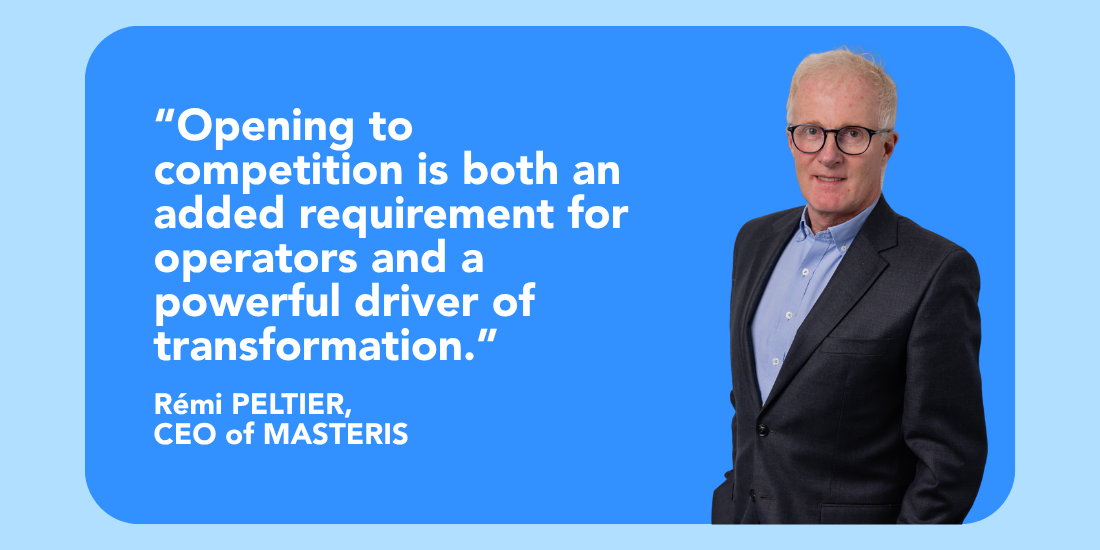
Ahead of the InnoTrans trade fair in Berlin, Rémi PELTIER, CEO of MASTERIS, shares his insights on current market trends.
The rail sector is undergoing significant changes in Europe as markets continue to open up to competition. Is this an additional burden for operators, or a genuine catalyst for transformation?
Market liberalization is both an additional requirement for operators and a powerful catalyst for transformation. Entering a new market involves more than just running trains: you must demonstrate equipment compliance, obtain the necessary authorizations, build an efficient maintenance organization, offer a compelling service, control costs, adapt service quality, and ensure both safety and maximum rolling stock availability. At MASTERIS, our role is to provide our industrial and engineering expertise, including maintenance engineering, certification, equipment approval, maintenance plan optimization, mid-life overhauls, and service life extensions.
More generally, what changes are you seeing in the expectations of operators and rolling stock owners?
Every operator wants to increase fleet availability, reliability, and lifespan while reducing costs. What has changed is the increasingly tight timeframe: the continuous growth of rail traffic in France and across Europe is putting significant pressure on all stakeholders. Our role is to meet these expectations with innovative solutions, such as predictive maintenance to prevent breakdowns and forced downtime, as well as life extension, maintenance plan adaptation, repair optimization, and secure parts supply.
How is the green transition shaping these expectations?
Improving energy performance and reducing the environmental footprint of fleets is at the heart of our priorities. We support operators in greening their diesel fleets with various solutions tailored to specific uses and constraints, including biofuels, battery-powered trains, hybridization, and biogas. We also rely on tools to measure, model, and optimize energy consumption, such as the SIM3PO digital twin for simulating train energy performance, Climax for optimizing HVAC system energy consumption, and our testing capabilities, particularly for batteries.
That said, I don't believe there is a one-size-fits-all solution. Every fleet, every piece of equipment, and every operation has its own unique constraints. Our added value lies in working with our clients to build the most relevant solution for their specific situation.
What role does MASTERIS intend to play for its clients amidst this profound shift in the rail landscape?
We aim to be more than just a technical service provider; we want to be a performance partner for rolling stock operators and owners.
Our strength in achieving this? Our ability to intervene across the entire equipment lifecycle—engineering, renovation, modernization, parts management, and repair—with an approach that combines technical expertise with operational reality.
Furthermore, our employees come from diverse backgrounds—manufacturers, equipment suppliers, consulting—bringing a variety of experiences and know-how that allows us to take a cross-functional view of rolling stock. Our teams are capable of working on a wide range of equipment, technologies, and challenges, combining expertise to provide each client with solutions tailored to their specific needs.
To learn more about our work, visit our stand for an overview of our expertise across high-speed, regional, locomotive, freight, and urban transport sectors.
The MASTERIS team looks forward to seeing you at stand 840, hall 6.2 at InnoTrans to discuss your needs, share experiences, and explore existing solutions!
Resources and news

Your rolling stock, always on track.
Let's discuss your project together: a dedicated expert accompanies you at each stage.