.svg)


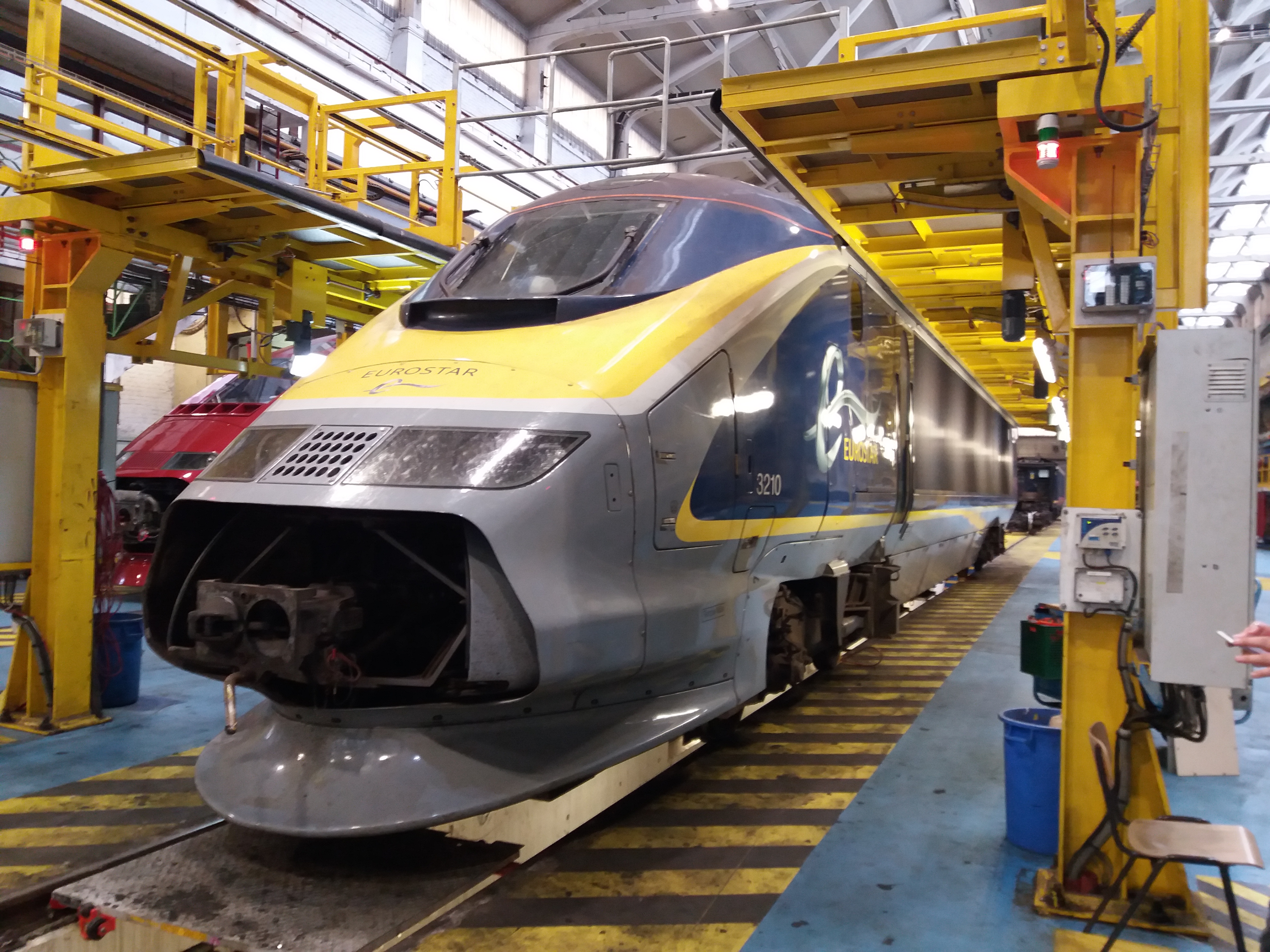
TBL1+, the safety equipment developed by Alstom for the Belgian railway signaling system
In Belgium, the installation of TBL1+ was mandated to upgrade the national signaling system. It replaces the TBL1, a safety system where signal status was transmitted to a train equipped with a passive antenna via a specific trackside beacon emitting a magnetic field. TBL1+ is similar, except that the contactless train-to-ground communication is handled by an euroantenna installed on the train and an eurobalise on the track. Furthermore, this system distinguishes itself from its predecessor by its ability to verify that the train's speed does not exceed 40 km/h on sections where this limit applies.
Eurostar equips its trainsets with TBL1+ for compatibility with the Belgian signaling system
Eurostar's goal is to extend the operational life of its E300 trainsets in Belgium, which are currently equipped with TBL1. To do this, it is necessary to install TBL1+ on its trainsets before this system fully replaces TBL1 on the Belgian rail network in December 2022.
The installation was carried out on a first prototype power car at the Hellemmes industrial technicentre. The system mainly consists of the euroantenna located under the car body, as well as an electronic drawer—the processing unit—installed in a cabin cabinet. This drawer is used to decode the information captured by the antenna from the trackside eurobalise. This translated information is then relayed to the driver via an interface located at the driving station.
The purpose of this equipment is, of course, to assist the driver by ensuring signal repetition in the cab and sending warning signals when necessary.
The installation of this equipment is complete on the prototype and will now continue on the series, i.e., on the remaining 8 trainsets.
A MASTERIS/SNCF Rolling Stock Division collaboration
A team with diverse expertise had to be assembled to carry out this project following the signing of the contract at the end of 2018. The SNCF Rolling Stock Division is managing the project-related studies through the North and East engineering clusters as well as the Rolling Stock Engineering Center. The installation on the trains is carried out by the teams at the SNCF Hellemmes industrial technicentre.
MASTERIS, as project manager, handles client interface and activity coordination, among other things, through its Projects and Purchasing Department. The MASTERIS Engineering Business Unit is responsible for compiling the authorization application file submitted to the SSICF, one of the major components of which is the certification of the trainset modifications by Belgorail.
Despite the Covid-19 health crisis, the commitments in terms of deadlines were met. Indeed, the various teams mobilized to continue the installation during the lockdown.
Coming up: interoperability in Europe with ERTMS
The European Rail Traffic Management System (ERTMS) project began several years ago. At its inception, the mission was launched through a group of railway companies including Ansaldo STS, Alstom, Bombardier, Siemens, Thales, and Invensys. Europe is calling for a unified signaling system with a primary focus on interoperability.
In the meantime, trains required to operate under multiple signaling systems—there are about 20 in Europe—must be equipped with safety equipment compatible with each of them.
Several European countries have launched their transition campaigns to ERTMS. Belgium, for example, has set itself the goal of making the switch by 2025. Masteris will be able to assist operators who aim to prepare for this change.
Resources and news


.webp)
Your rolling stock, always on track.
Let's discuss your project together: a dedicated expert accompanies you at each stage.